Key Takeaways
- Loud snoring with gasping, choking or pauses in breathing can be a sign of obstructive sleep apnea (OSA), a medical condition that needs a proper diagnosis.
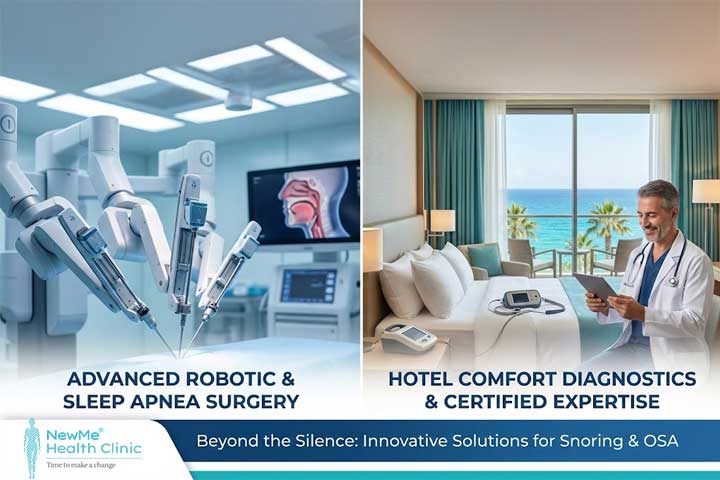
- Everything starts with an overnight sleep study (polysomnography). In Antalya it can be done in hospital or in your hotel room.
- CPAP is often the first treatment for moderate or severe OSA. Surgery helps selected patients, for example when a clear blockage is found or CPAP is not tolerated.
- At NewMe, ENT surgeons and a certified sleep medicine physician plan your treatment together at Anatolia Hospital in Antalya.
In this guide: Signs Diagnosis Is surgery right? Surgical options Recovery UK patients FAQ
Snoring is often treated as a joke, but for many people it is the main sign of obstructive sleep apnea, where the airway repeatedly narrows or closes during sleep. The right treatment depends on where your airway collapses and how severe the problem is. This guide explains how that is measured, when surgery makes sense, and what to expect if you come to Antalya for treatment. For the full treatment overview, see snoring and sleep apnea surgery at NewMe.
Is snoring a sign of sleep apnea?
Not always. Many people snore without having sleep apnea. These signs make OSA more likely and are worth checking with a doctor:
- Gasping, snorting or choking noises during sleep
- Your partner notices that you stop breathing for short periods
- Waking up tired even after a full night in bed
- Feeling very sleepy during the day, poor concentration or mood changes
- Morning headaches
Independent guidance: the NHS guide to sleep apnoea.
How is sleep apnea diagnosed?
Sleep apnea is diagnosed with an overnight sleep study. Sensors record your breathing, oxygen levels and sleep, and the result is given as an AHI score: the number of times per hour your breathing stops or becomes very shallow.
| Severity | AHI (events per hour) |
|---|---|
| Mild | 5–14 |
| Moderate | 15–30 |
| Severe | More than 30 |
At NewMe, the sleep study (polysomnography) takes place during your stay in Antalya, either in the hospital or, if you sleep better there, in your hotel room. Our ENT surgeons then examine your nose and throat to find exactly where the airway narrows, which is what decides the treatment.
Is surgery the right treatment for me?
Surgery is one option among several. For many people, weight loss, cutting down on alcohol and stopping smoking already reduce symptoms. For moderate or severe OSA, the usual first treatment is CPAP, a machine that keeps the airway open with gentle air pressure through a mask. A mouth guard that holds the lower jaw forward (mandibular advancement device) can help some people with milder OSA.
Surgery is usually considered when the sleep study and examination show a clear anatomical cause, such as a collapsing palate, a large tongue base or a blocked nose, or when someone cannot get on with CPAP.
Honest advice first: your plan is set by a certified sleep medicine physician together with our ENT team. If CPAP or another non-surgical treatment would serve you better, we will tell you before anything is booked.
Which surgical options are available?
Swipe the table on mobile →
| Procedure | What it does | Usually considered for |
|---|---|---|
| Expansion sphincter pharyngoplasty | Repositions the muscles of the soft palate to widen the airway, rather than simply removing tissue | Collapse at the level of the palate |
| Tongue base surgery | Reduces or stabilises the tongue base so it does not fall back during sleep | Collapse behind the tongue |
| Transoral robotic surgery | Gives the surgeon precise access to the tongue base and lower throat through the mouth | Selected patients with tongue-base obstruction |
| Laser-assisted uvulopalatoplasty (LAUP) | Trims and tightens soft palate tissue with a laser to reduce vibration | Snoring from the soft palate |
| Radiofrequency tissue reduction | Shrinks enlarged tissue in the nose or throat with radiofrequency energy | Milder cases and nasal blockage |
| Septoplasty and turbinate reduction | Straightens the nasal septum and reduces swollen turbinates to open the nose | A blocked nose, including people who struggle with CPAP |
Some patients need a combination of procedures, planned in one operation or in stages.
What is recovery like?
Arrival and sleep study
VIP transfer from Antalya airport, then your overnight sleep study in hospital or in your hotel room.
Results and examination
You go through the results with the sleep medicine physician and ENT surgeon, who examine your airway and agree the plan with you.
Surgery at Anatolia Hospital
An anaesthetist looks after you during surgery. Minimally invasive treatments usually need only a short stay; larger airway operations need a hospital stay.
The first weeks
A sore throat for 1–2 weeks, a temporary change in voice or taste, and tiredness in the first days are common. You fly home with an English-language report for your GP.
Around month 3: follow-up sleep study
A repeat sleep study measures how much your breathing during sleep has improved.
What should UK patients know before travelling?
- Bring previous results. Share any earlier sleep study or CPAP reports at your free assessment.
- Driving and the DVLA. If you have confirmed moderate or severe OSA that causes excessive sleepiness, you must tell the DVLA. See GOV.UK: sleep apnoea and driving.
- Do not stop CPAP on your own. Keep using it until your doctors confirm, with a follow-up sleep study, that you no longer need it.
- Keep your GP informed. Tell your GP before you travel; your English-language surgical report makes follow-up at home easier.
- Check entry rules. Read the GOV.UK entry requirements for Turkey before booking flights.
Frequently asked questions
Do I have to stay in hospital for the sleep test?
No. The overnight sleep study can be done in the hospital or in your hotel room, depending on your preference and what the doctors need to measure.
Can surgery replace my CPAP machine?
For some patients, yes. When surgery corrects the place where the airway collapses, many people can reduce or stop using CPAP. Not everyone can, so a follow-up sleep study measures the result before any change is made.
Is snoring surgery available on the NHS?
The NHS says surgery for snoring is not widely available and is usually only considered when other treatments have not helped. Sleep apnea on the NHS is mainly treated with lifestyle changes, CPAP or a mouth guard.
How long do I need to stay in Antalya?
It depends on the procedure. Minimally invasive treatments need a short stay; larger airway operations need a hospital stay plus a few days of recovery before flying. Your written, itemised plan lists the nights; hotel nights are booked separately from the treatment package.
What are the risks of sleep apnea surgery?
A sore throat, temporary changes in voice or taste, bleeding and infection are the main risks, and results depend on how severe your OSA is and where the airway collapses. Your ENT surgeon explains your personal risks before you book.
Considering treatment in Turkey?
Get a free, honest assessment from our medical team — no obligation, no pressure.
Free Assessment on WhatsApp